
- Local: (516) 346-4636
- Toll-Free: (800) 886-6060
- Email: kflynn@nationalwebbing.com
A strap that gradually loses its adjustment needs an assembly review before it needs stronger nylon webbing. Start by locating the movement. Is the textile sliding through an adjuster, stretching under load, pulling at a sewn attachment, or moving because the buckle is damaged? Those observations lead to different corrective actions. At National Webbing Products, we supply webbing, hardware, and finished assemblies, and we need to understand the actual combination before discussing an alternative.
Remove a suspect product from service wherever slippage could injure someone or release a hazardous load. Fall protection, lifting and restraint products require their applicable qualification and approval processes. A hand pull on a sample cannot establish safe performance for those uses. The investigation below helps organize a product-development discussion; it does not authorize continued use of an unsafe assembly.
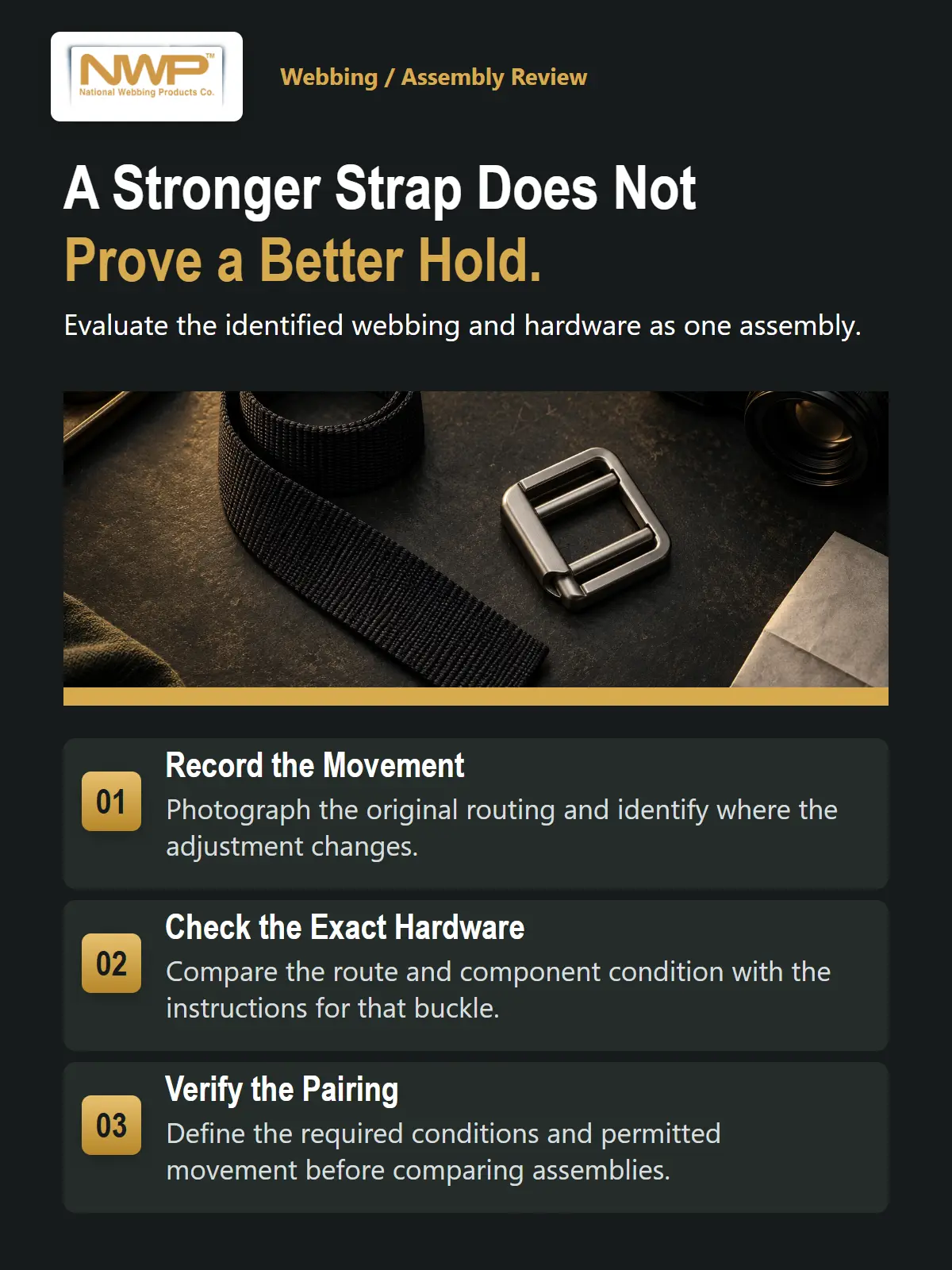
Photograph the routing as received, including both sides of the hardware and the free end of the strap. Record the webbing item, buckle part number, and relevant assembly revision. Describe when the adjustment changes, such as during a steady pull, repeated movement, or use after adjustment. When available, preserve an affected assembly and an accepted comparison sample rather than asking an operator to recreate the problem from memory.
This record matters because a change that appears to fix the symptom may also remove evidence of its cause. Rethreading a buckle before documenting the original route can make an assembly error difficult to confirm. Similarly, replacing webbing and hardware together may produce a sample that holds without revealing which change mattered.
Separate the buckle's release function from the strap's adjustment. A buckle can remain closed while webbing moves through its adjuster. Identify the mechanism before deciding what to inspect.
|
Component or function |
What the inspection must establish |
|
Ladder-style adjuster |
Whether the webbing follows the specified route around the bars of this exact component. |
|
Cam buckle |
Whether the closing mechanism traps the webbing as intended and is fully engaged. |
|
Side-release connection |
Whether the mating components engage correctly; this does not alone establish that the adjustment holds. |
|
Free strap end |
Whether its exit direction and any required retention match the specified assembly. |
Obtain the instructions for the exact hardware and compare them with the assembled route. Inspect for damage or unauthorized modification. Do not file teeth, bend a bar, or improvise a different route to make a sample grip; that creates a changed component or assembly requiring its own evaluation.
Matching nominal width establishes only part of the component pairing. Identify the webbing construction and relevant dimensions, and ask which material was used to establish any published hardware performance. If the buckle was approved with one webbing item, you still need to review another item of the same width. A purchasing substitution can therefore change the finished assembly even when the buckle part number stays the same.
Measure thickness using an agreed procedure because textile measurements depend on the pressure applied. Compare like conditions rather than an informal caliper reading against an unexplained catalog value. Keep textile strength separate from holding performance: a stronger strap does not, by itself, prove that it will resist movement through an adjuster. The acceptance requirement needs to address the assembled product and its intended use.
Consider an equipment bag whose strap begins losing adjustment after a webbing substitution. The buckle is unchanged, and the assembly team confirms that both versions are threaded correctly. A useful comparison tests the original approved pairing and the new pairing under the same defined conditions. If only the substituted material moves, that directs the investigation toward the change. It does not yet establish whether thickness, finish, construction, or another difference caused the result.
Have the responsible product or quality engineer define the load, duration, permitted movement, and repeated-use conditions before testing. Include relevant exposure conditions for the intended product. If you propose a different buckle, test it as another identified combination rather than assuming more aggressive teeth will solve the issue. Record the outcome and any effect on adjustment, release, or the textile itself.
A buckle-slippage fix is not complete until the identified strap and hardware, assembled by the specified route, meet the product's movement limit under the required conditions. Correct threading when routing is wrong; qualify a different pairing when the correctly assembled combination fails. Do not substitute a stronger strap for that distinction. Send National Webbing Products the component numbers, routing photographs, and comparison results so the next material or hardware discussion starts with the demonstrated problem.
