- Local: (516) 346-4636
- Toll-Free: (800) 886-6060
- Email: kflynn@nationalwebbing.com
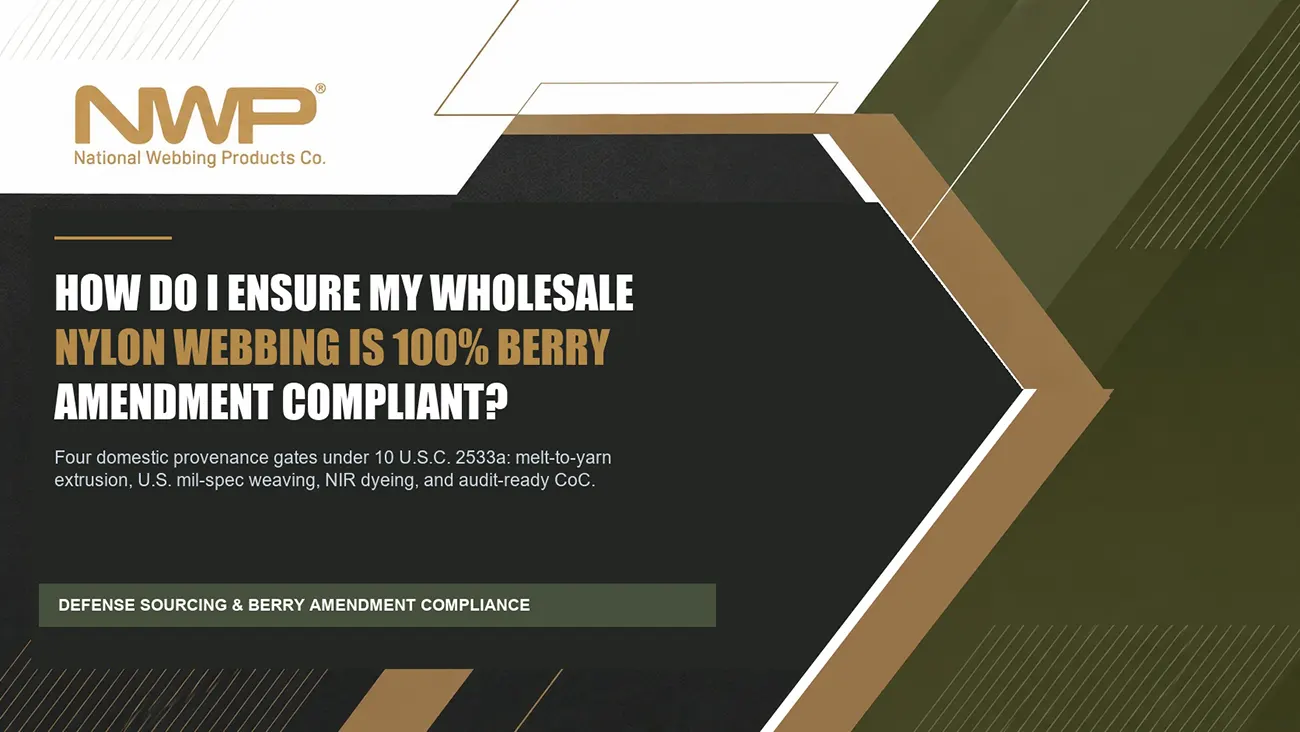
For defense contractors, tactical gear manufacturers, and military supply chain specialists, regulatory compliance is just as vital as physical tensile performance. When bidding on Department of Defense (DoD) contracts that incorporate nylon webbing—whether for modular lightweight load-carrying equipment (MOLLE), parachute harness assemblies, tactical body armor carriers, or aviation cargo restraints—suppliers encounter strict federal sourcing mandates. Foremost among these federal statutes is the Berry Amendment (codified at 10 U.S.C. 2533a). Inadvertently incorporating non-compliant imported narrow fabrics into military equipment can trigger immediate contract termination, severe civil penalties under the False Claims Act, and formal debarment from federal contracting.
The Berry Amendment is not a general preference or recommendation for American goods; it is a rigid statutory mandate governing the entire textile supply chain. Understanding the exact requirements of Berry compliance, how it differs fundamentally from other federal trade statutes, and how to verify complete domestic provenance from petrochemical polymer to finished woven tape is essential for every defense supplier.
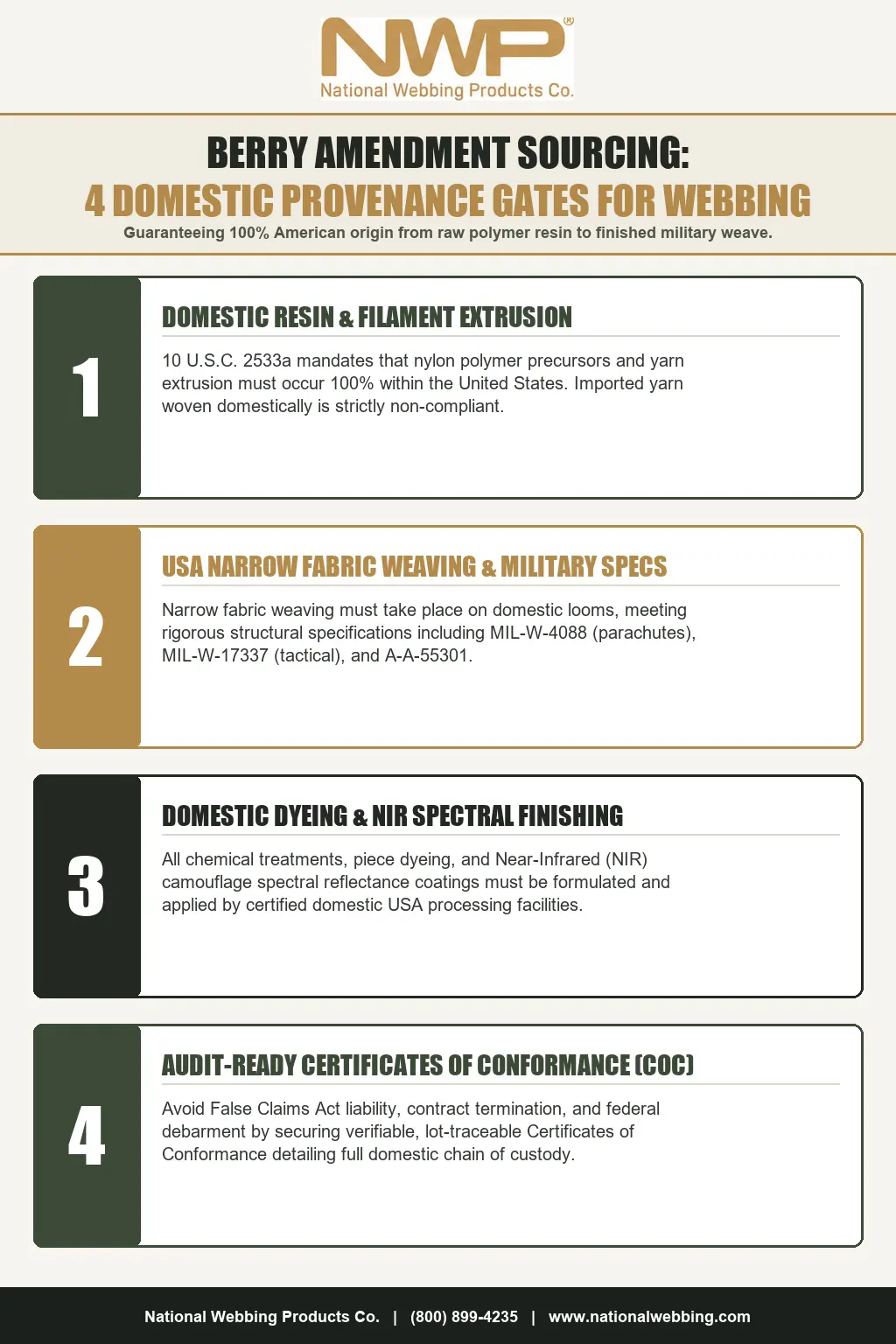
The most critical aspect of the Berry Amendment is its absolute, uncompromising domestic origin requirement. Unlike general commercial manufacturing, where assembling foreign components in a domestic plant qualifies as 'Made in USA,' the Berry Amendment requires that military textiles be 100% grown, reprocessed, reused, or produced in the United States. In the context of synthetic polyamide narrow fabrics, this domestic chain encompasses every stage of processing.
If a domestic weaver imports high-tenacity nylon yarn from overseas and weaves it into MIL-W-4088 webbing in an American mill, that narrow fabric is illegal for DoD procurement under Berry. The origin of the underlying filament is just as regulated as the weaving process itself.
Defense procurement officers often confuse three distinct federal sourcing regulations. Understanding the differences between these statutes is vital to avoiding costly contract compliance errors.
|
Statutory Dimension |
Berry Amendment (10 U.S.C. 2533a) |
Buy American Act (BAA - 41 U.S.C. 8301) |
Trade Agreements Act (TAA - 19 U.S.C. 2501) |
|
Applicable Agency |
Exclusively Department of Defense (DoD) |
All federal government agencies |
Federal agencies with qualifying high-value contracts |
|
Covered Products |
Textiles, apparel, footwear, food, specialty metals |
Manufactured end products and construction materials |
End products covered by international trade pacts |
|
Domestic Content Rule |
Strict 100% domestic origin from raw fiber up |
Requires >65% domestic content (rising to 75% by 2029) |
Waives BAA for designated trade partner nations |
|
Substantial Transformation |
Not permitted; weaving foreign yarn is non-compliant |
Permitted; transforming foreign parts into new product qualifies |
Permitted; product must be substantially transformed in partner nation |
|
DoD Textile Threshold |
Applies to DoD purchases exceeding SAT ($250,000) |
Applies to lower-threshold civilian federal goods |
Expressly overridden by Berry for DoD textile items |
Military prime contractors rely on certified domestic narrow fabrics across a wide variety of defense specifications, each engineered for dedicated tactical environments.
In defense contracting, an unsubstantiated claim of domestic origin is worthless during a Defense Contract Management Agency (DCMA) audit. Prime contractors must establish an unbroken, documented chain of custody from the certified polymer producer down to the final cut-and-sew facility. Every shipment of Berry-compliant narrow fabrics must include a formal Certificate of Conformance (CoC).
A legally defensible CoC explicitly references 10 U.S.C. 2533a, certifies the specific military specification and class, details the manufacturing lot number, and cites domestic mill locations for yarn extrusion, weaving, and finishing. Narrow fabrics intended for combat uniforms and tactical gear must also include spectrophotometric test reports proving compliance with MIL-DTL-44436 for near-infrared (NIR) signature management, ensuring webbing matches camouflage patterns when viewed through night vision devices.
Even experienced defense contractors can run afoul of the Berry Amendment through subtle supply chain oversights. One common trap involves commercial 'Buy American' catalog items where webbing was woven in the United States using imported nylon yarn. While compliant with certain civilian procurement rules, this completely violates the Berry Amendment's 100% domestic rule.
Another frequent compliance gap occurs when purchasing assemblies with pre-attached hardware. If tactical straps feature imported adjustment slides or non-exempt plastic buckles, the entire assembly may fail DCMA source inspection. Military prime contractors must implement rigorous vendor qualification audits, demand full sub-tier supplier disclosures, and verify that every fiber, dye lot, and resin coating can be traced back to its domestic point of origin.
Navigating the complexities of Department of Defense textile procurement demands absolute vigilance across every tier of the supply chain. For defense gear manufacturers, partner qualification is the ultimate safeguard against project delays, delivery rejections, and legal exposure.
By partnering directly with established domestic narrow fabric mills with dedicated Berry-compliant production lines, defense contractors ensure every foot of webbing meets rigorous military specifications. Reliable domestic sourcing secures defense supply chains, protects military personnel in field operations, and ensures complete statutory compliance on every government contract.
