
- Local: (516) 346-4636
- Toll-Free: (800) 886-6060
- Fax: (516) 346-4366
- Email: kflynn@nationalwebbing.com
When an ironworker, cell tower technician, or commercial bridge painter slips from an elevated structural beam, the physics of fall arrest unfold in less than eight-tenths of a second. A 220-pound worker dropping six feet generates over 5,000 pounds of instantaneous impact force. For life-safety equipment manufacturers specifying nylon webbing, selecting narrow fabrics is never a routine procurement decision; it is a life-critical exercise in managing kinetic energy. Under OSHA standard 1926.502 and ANSI Z359 guidelines, maximum arresting force (MAF) transmitted to the human body must never exceed 1,800 pounds. Achieving that threshold requires structural webbing engineered to yield elastically, dampening deceleration spikes before shock waves shatter vertebrae or rupture internal organs.
Industrial fall arrest systems operate where heavy friction, abrasive concrete edges, and chemical exposure threaten strap integrity. While generic commercial strapping might show adequate break strength in a static factory test, its dynamic behavior during a shock-arrest event can be catastrophic. Understanding how military-specification narrow fabrics behave under violent shock loads reveals why mil-spec polyamide remains the benchmark for safety harness engineering.
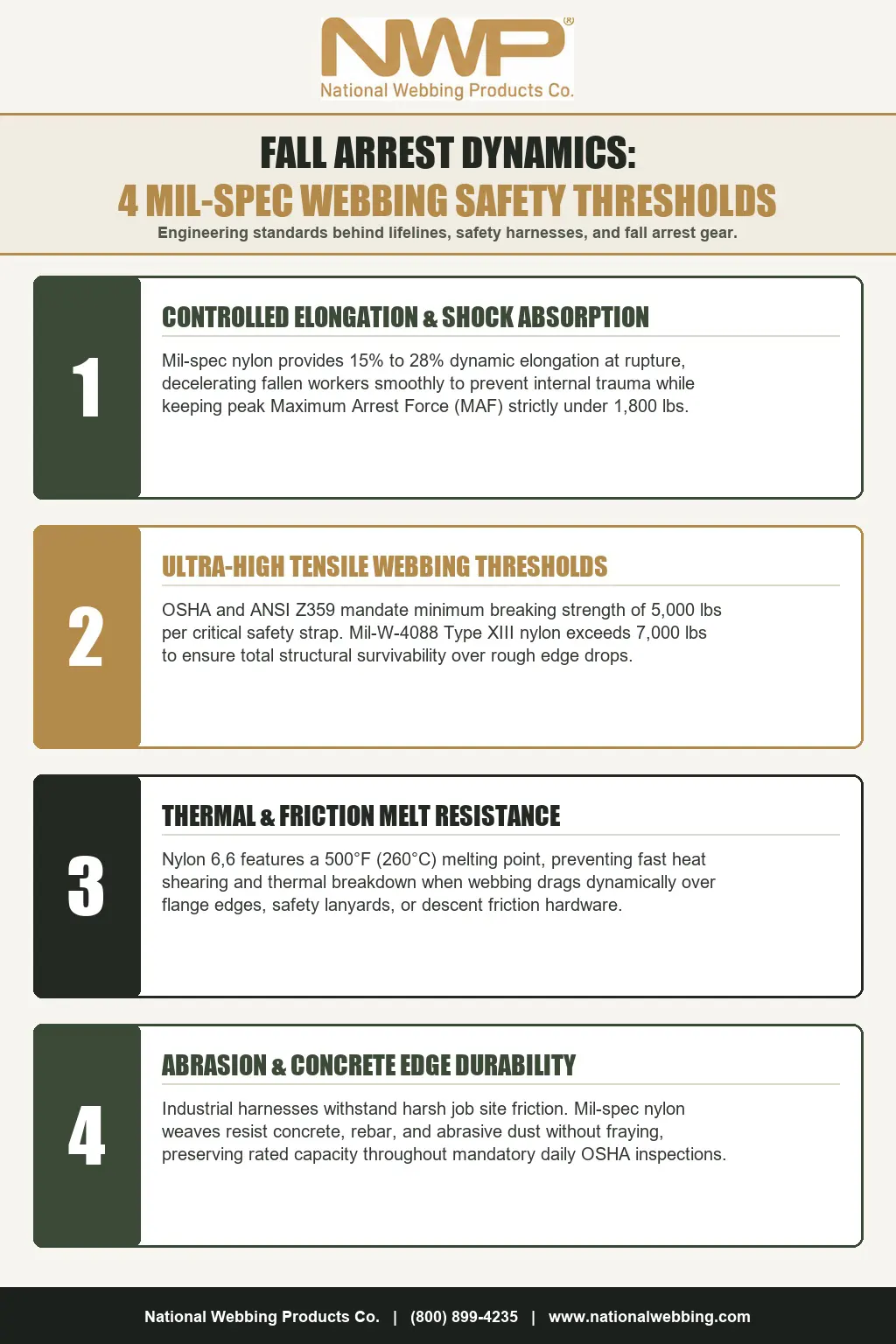
The superior shock attenuation of military-grade nylon stems from its crystalline molecular architecture. Synthetic fibers used in narrow fabrics generally fall into three categories: polyamide (nylon), polyester, and polypropylene. Continuous-filament Type 6,6 nylon exhibits a unique balance of molecular orientation and elastic elongation under high strain rates.
In contrast, commercial polyester stretches merely 5% to 10% under load. While low elongation is ideal for static cargo tie-downs where load shifting must be avoided, in fall arrest that rigidity transfers brutal deceleration forces directly into the worker's skeletal structure. Polypropylene is even more perilous, with a low melting point of 330°F (165°C) that can cause straps to melt through buckle pass-throughs under rapid sliding friction.
Performance Metric | Mil-Spec Nylon 6,6 (MIL-W-4088) | Industrial Grade Polyester | Commercial Polypropylene |
Dynamic Elongation at Break | 15% to 28% (progressive dampening) | 5% to 10% (rigid shock transfer) | 12% to 20% (erratic, unverified) |
Thermal Melting Point | 500°F (260°C); resists buckle friction | 480°F (248°C); acceptable thermal rating | 330°F (165°C); melts under rapid slip |
Edge Cut & Tear Resistance | Superior; dense shuttle-woven selvage | Moderate; prone to transverse notch split | Extremely poor; fibrillates and shreds |
Resistance to Alkalis | High resistance to basic chemicals/soaps | Degraded by strong alkalis and bleach | Inert to most common chemicals |
Life-Safety Suitability | Mandatory for dynamic fall arrest | Primarily for static positioning lines | Prohibited in personal fall arrest systems |
Tensile ratings on a spec sheet do not describe how a strap behaves when scraped against a rusted steel flange. The physical construction of the strap's edges—known as the selvage—is where safety harnesses succeed or fail. Commercial webbing is woven on high-speed needle looms. To lock weft yarns in place, a needle loom uses an auxiliary knitting hook that knits a single catch thread along one edge of the strap.
This knitted edge represents a vulnerability. If an ironworker brushes against an abrasive column and nicks that exterior catch thread, the entire longitudinal weave can unravel under tension, causing a catastrophic 'zipper' failure across the web. In contrast, military specifications like MIL-W-4088 mandate shuttle-woven constructions with integral, lock-stitched selvages. The filling yarn travels continuously back and forth across the entire width. Even if the outer edge suffers abrasive scraping, the weave structure isolates the damage, keeping the tensile core fully intact.
Construction sites subject safety harnesses to abrasive concrete slurry, airborne silica dust, cutting oils, and solar UV radiation. Untreated nylon naturally absorbs atmospheric moisture. As water enters the yarn matrix, it carries fine abrasive sand particles deep between filaments. Under cyclic body movement, these microscopic quartz crystals act like serrated blades, severing load-bearing filaments from within.
To eliminate internal fiber wear, military-grade narrow fabrics utilize specialized chemical resin treatments defined by federal standards.
Validating narrow fabrics for fall arrest requires testing far beyond static pulling. Quality assurance laboratories subject mil-spec harness webbing to rigorous testing protocols under ASTM D6775 and Federal Standard 191. Split-drum capstan grips pull samples to destruction to confirm rated capacities like 7,000 pounds for MIL-W-4088 Type XIII and 9,500 pounds for Type XXVII.
Next, oscillating hex-bar abrasion testing cycles the webbing over a hardened steel hexagonal bar under continuous tension for thousands of cycles, measuring retained break strength to verify selvage durability. Finally, instrumented drop towers drop a rigid 220-pound anthropomorphic test torso in a free fall, recording dynamic load cell curves to ensure maximum arrest force remains within statutory limits.
For manufacturers of fall protection gear, tactical load-carriage systems, and search-and-rescue harnesses, narrow fabric procurement forms the bedrock of product safety and corporate risk management. A single manufacturing flaw or uncertified material substitution can trigger catastrophic product recalls and fatal jobsite accidents.
Collaborating with established domestic narrow fabric mills guarantees complete lot traceability, verified yarn origins, and certified compliance with MIL-W-4088 and ANSI Z359 requirements. By demanding verified tensile reports, certified resin finishes, and shuttle-woven selvage integrity, equipment designers deliver the uncompromising reliability workers depend on when their lives hang in the balance.
