
- Local: (516) 346-4636
- Toll-Free: (800) 886-6060
- Email: kflynn@nationalwebbing.com
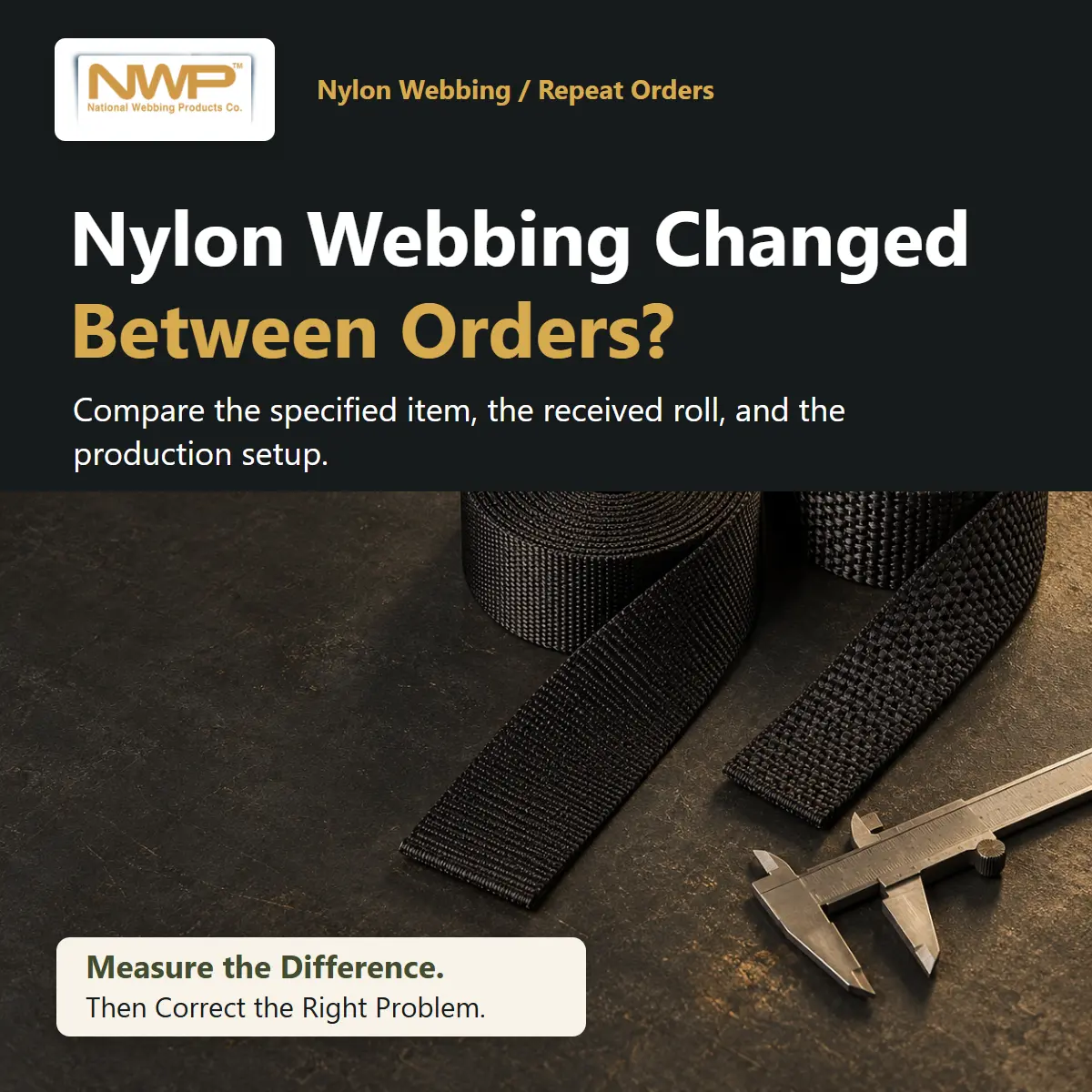
A repeat shipment of nylon webbing can have the right color and nominal width yet behave differently in your assembly process. Before adjusting a machine or choosing another material, compare the ordered item, the material you received, and your production setup. At National Webbing Products, we offer nylon webbing in different constructions, widths, and colors. Identifying the exact item and the problem you need it to solve gives us a more useful starting point than a request for a roll that feels like the last one.
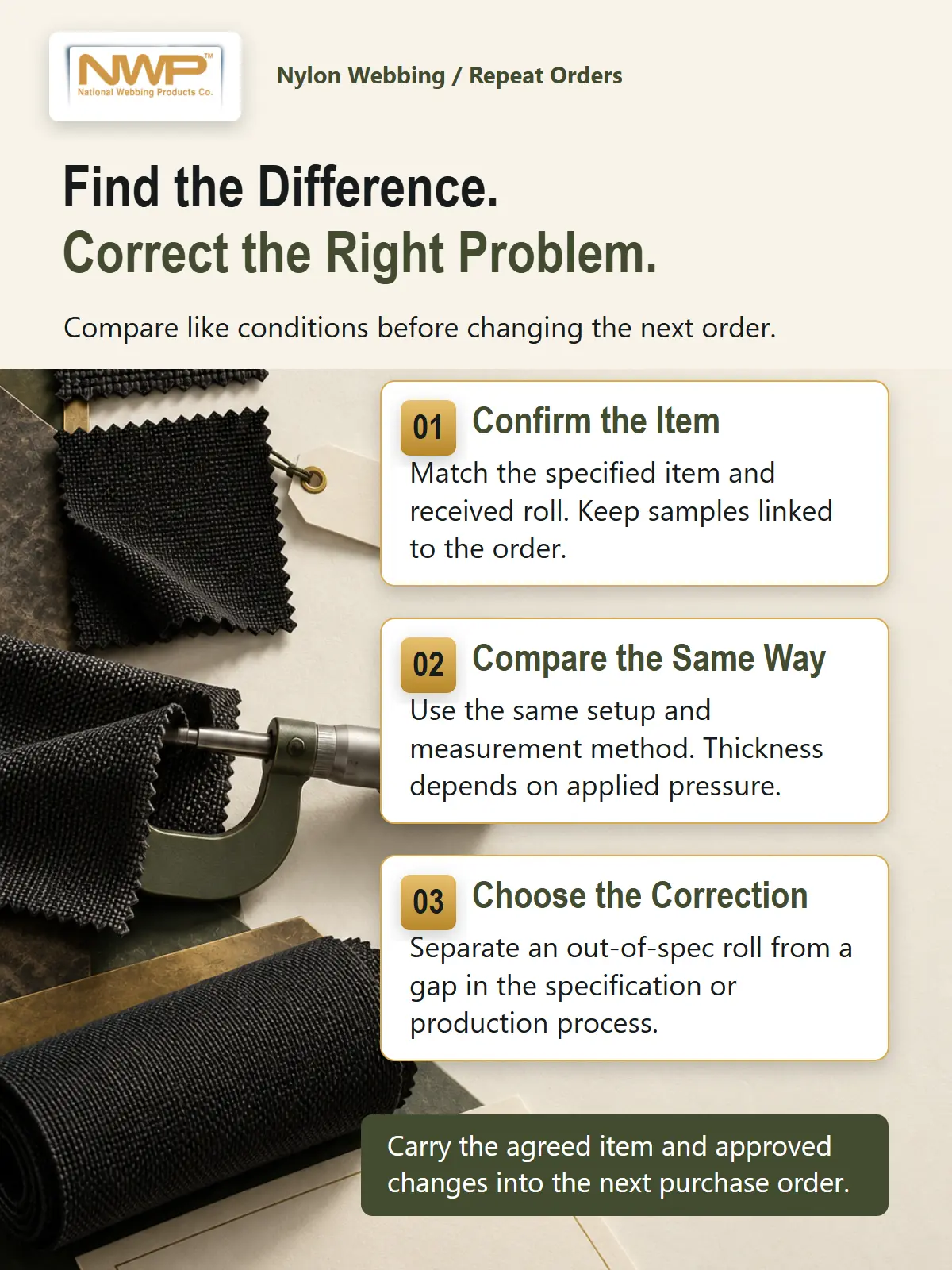
Describe where the change appears. A roll may catch in a feed guide, resist folding at a seam, or sit differently in hardware. Each observation points to a different comparison. Keep an identified sample of the questioned material and, when available, a retained sample from an accepted shipment. Record the roll information before cutting samples so they remain connected to the order.
Check the supplier item number, purchase order, and relevant drawing revision. A description such as black nylon webbing does not, by itself, establish a construction, dimensional tolerance, or performance requirement. Our product range includes lightweight and heavyweight options as well as tape, so a similar appearance is not a reliable way to identify the selected product. Confirm whether the shipment contains the approved item or an authorized alternative.
|
Observed difference |
Comparison to make |
|
Catches in a guide |
Approved width requirement, actual measurements, and unchanged guide setup. |
|
Changes a folded or sewn section |
Construction, thickness measured consistently, and the assembly arrangement. |
|
Feels stiffer |
Identified item and the specific folding, feeding, or handling task affected. |
|
Interrupts cutting or unwinding |
Roll format, join or splice requirements, and the actual interruption record. |
This comparison separates a shipment outside the agreed specification from a specification that does not control an important feature. Both deserve attention, but they require different responses. A documented nonconformance needs resolution against the existing agreement. If two acceptable materials behave differently in your process, you may need to develop a more precise requirement for the next order with your quality team and supplier.
Use the same agreed procedure for the retained material and the questioned material. Record the instrument, sample identification, and measurement conditions. Textile thickness is particularly sensitive to the pressure applied during measurement. Two readings taken with different contact pressures can therefore disagree without establishing that the product changed. Agree on an appropriate method before comparing your result with a supplier's value.
A strength result also has a limited purpose. It can address the textile's breaking strength or elongation under the relevant method. Still, it does not establish that the material will feed through your equipment or hold in a particular adjuster. Keep those requirements separate. A material that meets a strength requirement may still need an assembly or process check before approval for your product.
Suppose an accepted roll passes through a cutting-machine guide while a new roll catches at the same point. First, confirm that both samples are the specified item and that the guide setup hasn't changed. If comparable measurements show the new roll exceeds the agreed width limit, send the supplier a specific discrepancy. Include the order, roll identification, measurements, and affected samples rather than describing the entire shipment as inconsistent.
If both rolls meet the width requirement, investigate the feature that the first comparison did not capture. The result may call for a construction review or a better-defined process requirement. It does not justify assigning an arbitrary tighter tolerance after delivery. Agree on the revised requirement, determine whether the proposed product can meet it, and check it in the assembly before using it for the next order.
Keep the accepted sample, but put the purchasing requirements in writing. State the approved item, relevant dimensions and measurement methods, required performance checks, roll format, and any agreed restrictions on joins or substitutions. Use a military specification when the application or contract requires it, not just because a buckle fits closely. A specification name does not replace the need to establish suitability for the actual product.
Close the investigation by establishing whether the roll missed an agreed requirement or met it while exposing a gap in the specification or process. Those findings call for different corrections; ordering another roll without that distinction leaves the repeat-order problem unresolved. Record the accepted item and any approved change in the next purchase requirement. Send National Webbing Products the item and roll identification, comparison measurements, and affected setup so the discussion addresses the demonstrated difference.
