
- Local: (516) 346-4636
- Toll-Free: (800) 886-6060
- Email: kflynn@nationalwebbing.com
A finished-assembly sample is useful only when everyone agrees on what it should represent. A request such as “one-inch nylon strap with a buckle” still leaves the material construction, measured dimensions, hardware, routing, attachment, tolerances, and approval criteria undefined. Those gaps usually surface after the first sample arrives, when changes cost more time than they would have during specification. At National Webbing, we work with manufacturers, designers, and purchasing teams to turn the intended product into a specification that can be quoted, sampled, reviewed, and reproduced. The purpose is not to make the document unnecessarily technical; it is to remove the decisions that would otherwise be left to assumption.
The specification should begin with what the strap must do in the finished product. A strap used as a handle, an adjustable restraint, a closure, or a mounting component may use the same fiber but place very different demands on the webbing and its attachment. The designer should describe how force reaches the strap, how often the user handles it, which components it contacts, and what happens if it stretches, slips, twists, or releases. This application information gives us a basis for evaluating construction and assembly choices, rather than treating nylon as a complete specification on its own.
These questions also prevent an article or sample request from drifting into a generic list of nylon properties. A material can look appropriate in isolation and still be wrong for the routing space, hardware, sewing operation, or service environment. The specification therefore needs to connect every requested property to an actual use condition. If a requirement cannot be traced to the product, it probably does not belong in the first sample.
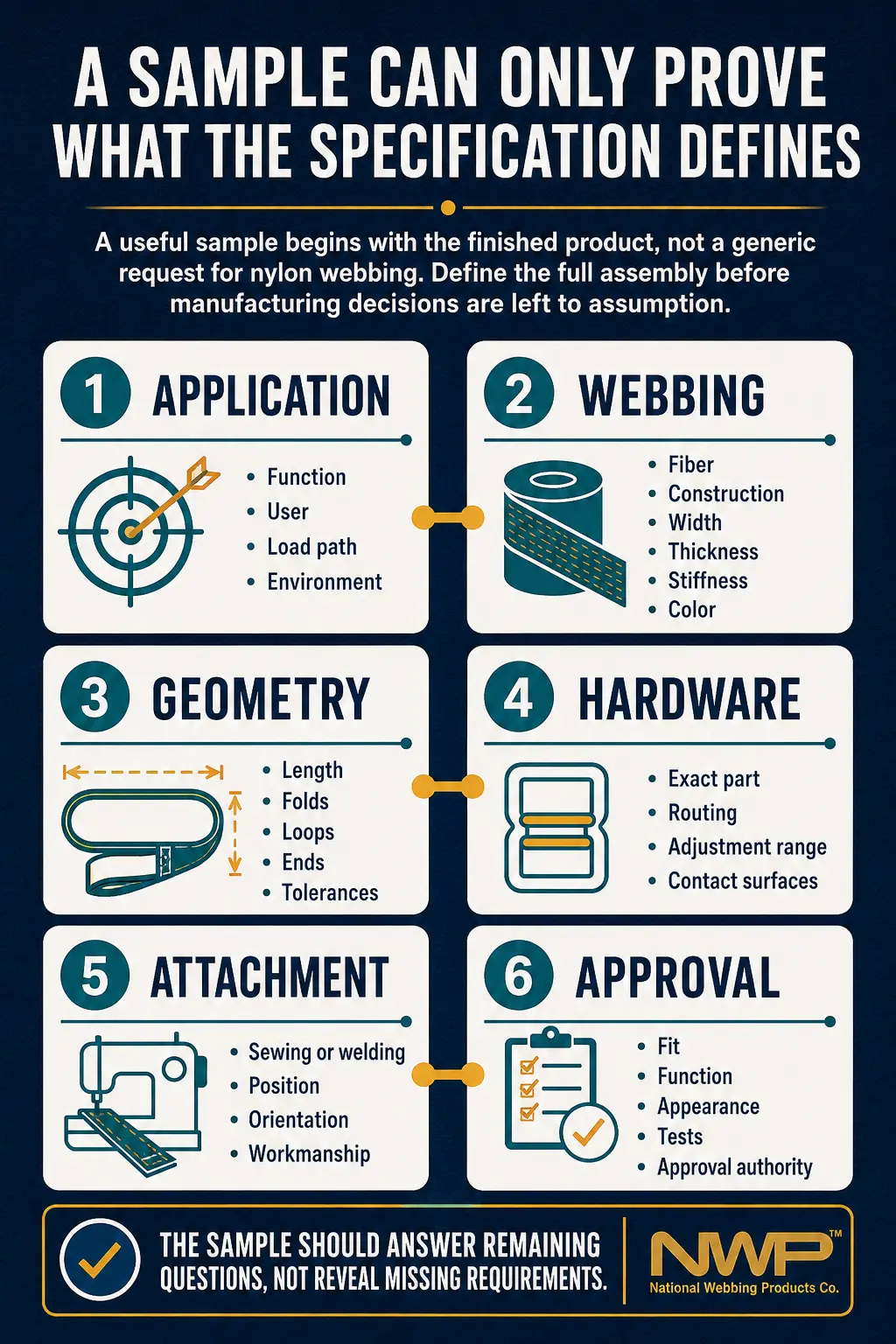
Width is important, but it is only one part of the webbing definition. The specification may also need to identify the fiber, weave or construction, thickness, weight, stiffness or hand, surface, edge configuration, color, and finish. ASTM D3774 treats width as a measured textile characteristic, while ASTM D1388 treats stiffness as a separate property. That distinction matters because two materials with the same nominal width can bend, sew, fold, and route through hardware differently.
Appearance requirements also need usable limits. “Navy,” “smooth,” or “soft” may communicate an intention, but they do not establish an approval method or tolerance. When color, finish, logo treatment, or visible end quality matters, the specification should identify the approved reference, viewing or comparison method, and which variations are acceptable. This keeps cosmetic preference from being mistaken for a performance requirement and keeps performance issues from being dismissed as cosmetic.
Once the webbing is defined, the specification must describe what happens to it. Finished length, cut method, end treatment, folds, loops, holes, free-tail length, orientation, and tolerance all affect how the strap fits the larger product. Identify hardware by an exact part or approved sample, not just a nominal slot width. Include the routing path and pull direction in a drawing whenever the assembly can be threaded more than one way.
The attachment belongs in the same specification because it connects the material to the finished function. ASTM D6193 separates stitch and seam types and identifies multiple variables that influence a sewn construction. National Webbing’s assembly capabilities include sewing, ultrasonic welding, cutting, punching, hook and loop, and hardware integration, but availability does not make those processes interchangeable. The specification should name the selected method, its location and orientation, and the performance or workmanship criteria that the sample must meet.
|
Specification Area |
What to Define |
Why It Must Be Settled Before Sampling |
|
Application |
Function, user, load direction, use frequency, and service conditions. |
Sets the relevant material, geometry, and validation requirements. |
|
Webbing |
Fiber, construction, measured width, thickness, stiffness, surface, color, and finish. |
Nominal width and “nylon” alone do not establish fit. |
|
Finished geometry |
Length, tolerances, folds, loops, holes, ends, free tails, and orientation. |
Allows the sample to demonstrate actual installation and adjustment. |
|
Hardware and routing |
Exact component, threading path, adjustment range, contact surfaces, and pull direction. |
Prevents width-only compatibility assumptions and routing errors. |
|
Attachment |
Method, pattern or bond area, location, orientation, and workmanship limits. |
Controls how force transfers through the completed strap. |
|
Approval |
Critical dimensions, functional checks, appearance reference, test criteria, and approval authority. |
Defines what the sample must prove and how acceptance is recorded. |
This table doesn't mean every strap specification must be a long engineering document. A simple assembly may need only a drawing, a material reference, a hardware sample, a few controlled dimensions, and clear workmanship notes. A more demanding product may require testing, compliance information, or several approval samples. The right level of detail prevents guesswork from driving a meaningful production decision.
The most useful inquiry package keeps the drawing, reference materials, commercial assumptions, and approval criteria together. That lets our team review the design as an assembly and identify missing decisions before we make the first sample. It also gives purchasing and design teams a single controlled reference point when revisions occur. The following items are usually more valuable than a long narrative description.
At National Webbing, we can supply raw webbing, cut pieces, and completed strap and cord assemblies, so we should also make the boundary of our responsibility explicit. If another supplier installs the strap, performs the final sewing, or validates the end product, the specification should say so. Clear ownership prevents approving one component from being interpreted as approval of a complete product we did not build or test. It also helps us focus our recommendations on the part of the design we can actually control.
A finished-assembly specification should define the product use, the webbing, the final geometry, the hardware interface, the attachment method, and the criteria for approval. Those details give the sample a clear job and make feedback specific enough to act on. They also reduce avoidable revisions without pretending that a document can replace physical validation. When the interface is uncertain, send National Webbing the drawing and representative components so we can review the assembly before sampling. The goal is a sample that answers the remaining questions, not one that reveals questions the specification should already have resolved.
