
- Local: (516) 346-4636
- Toll-Free: (800) 886-6060
- Email: kflynn@nationalwebbing.com
In heavy industrial rigging, mobile crane operations, and warehouse material handling, confusing minimum breaking strength with working capacity is a leading contributor to catastrophic rigging failures. When plant engineers and lifting supervisors evaluate synthetic nylon webbing slings, they must navigate a precise framework of engineering safety factors, geometric hitch multipliers, and environmental derating criteria. A synthetic webbing sling labeled with a 10,000-pound breaking strength cannot legally or safely pick a 9,000-pound machine base; doing so directly violates Occupational Safety and Health Administration (OSHA) regulations and American Society of Mechanical Engineers (ASME) B30.9 standards.
The Working Load Limit (WLL)—often referred to in field documentation as the rated capacity—represents the absolute maximum static weight a sling is permitted to support in a specific rigging configuration. Calculating WLL is not a matter of informal rule-of-thumb guessing. It requires strict mathematical modeling that factors in the fundamental design safety margin, the physics of angular hitch vectors, and hardware contact radii.
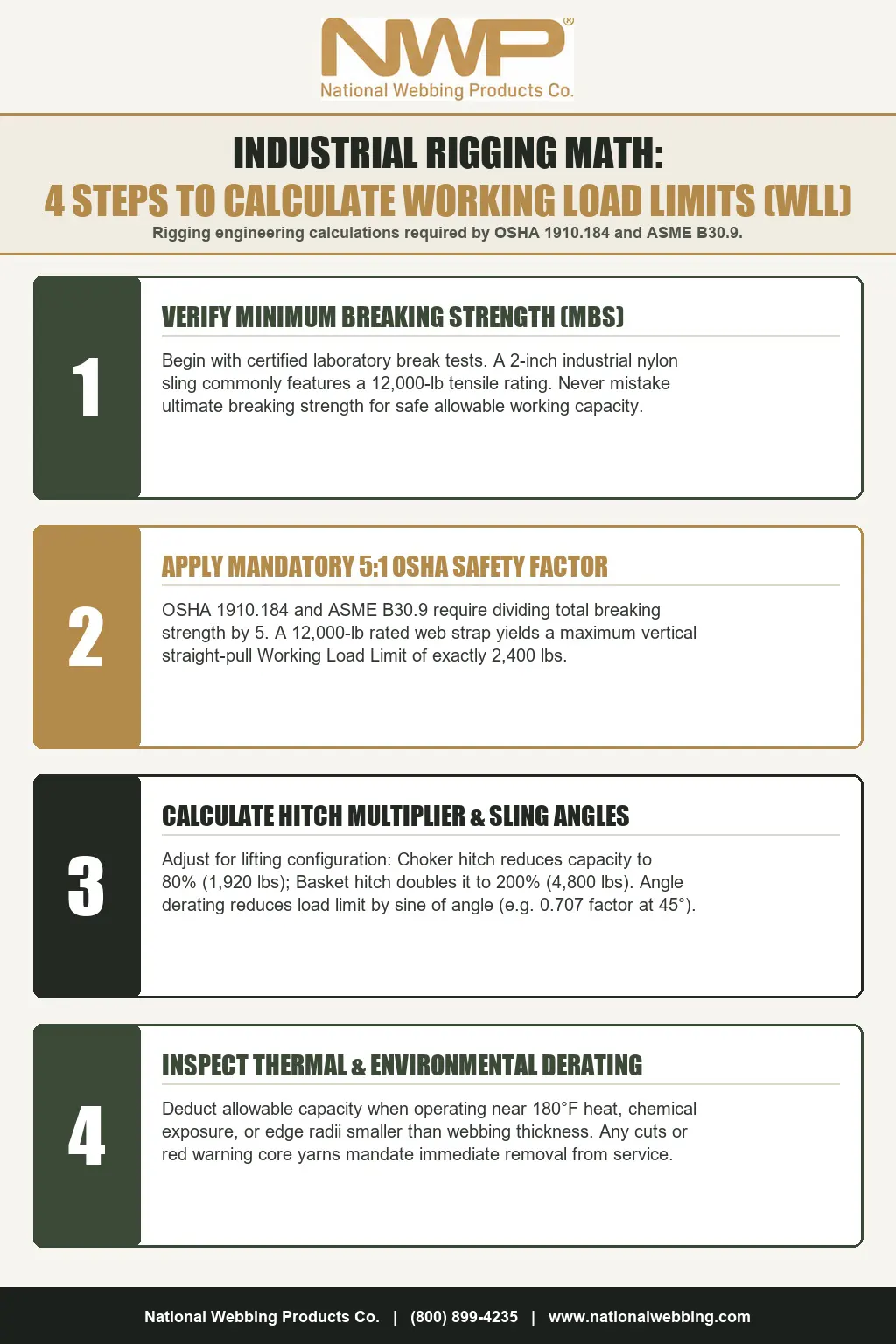
Under OSHA Standard 1910.184 and the Web Sling & Tie Down Association (WSTDA) specifications, all synthetic web slings manufactured for overhead lifting must maintain a minimum design factor of 5:1. This means the baseline Working Load Limit for a straight vertical lift is calculated with the straightforward formula: WLL = Minimum Breaking Strength (MBS) / 5.
For example, an industrial heavy-duty 2-inch two-ply nylon sling with a tested ultimate breaking strength of 16,000 pounds receives a rated vertical Working Load Limit of exactly 3,200 pounds. Far from being 'excessive' or wasted capacity, this 80% safety cushion is essential to accommodate severe dynamic and environmental variables encountered on the plant floor.
A sling rarely pulls in a pure, unencumbered vertical orientation. The mechanical configuration—or hitch—used to connect the synthetic strap to the load fundamentally modifies its working capacity. The three standardized hitch arrangements utilize specific geometric capacity multipliers.
When a basket hitch or multi-leg bridle is rigged at an angle rather than straight up and down, the tension in each sling leg increases dramatically. This occurs because the sling must not only support the vertical downward pull of gravity, but must also resist substantial inward horizontal compressive forces. Rigging engineers calculate tension per leg using the trigonometric sine of the horizontal sling angle.
Tension per Leg = (Total Load Weight / Number of Legs) / sin(Horizontal Angle). As the angle between the sling leg and the horizontal plane flattens, the sine of the angle shrinks, causing the resulting tension to spike exponentially.
|
Horizontal Sling Angle |
Sine of Angle (sin θ) |
Load Tension Multiplier (1 / sin θ) |
Effective 2-Leg Basket Capacity (vs Vertical WLL) |
|
90° (True Vertical) |
1.000 |
1.000 |
2.000 (200% of WLL) |
|
60° (Equilateral Triangle) |
0.866 |
1.155 |
1.732 (173% of WLL) |
|
45° (Square Bridle) |
0.707 |
1.414 |
1.414 (141% of WLL) |
|
30° (Critical Minimum Angle) |
0.500 |
2.000 |
1.000 (100% of WLL) |
|
< 30° (Extreme Danger Zone) |
< 0.500 |
> 2.000 (Rapid Spike) |
Prohibited by OSHA / ASME B30.9 |
Consider a practical rigging example: a crew must hoist a 12,000-pound industrial chiller using a two-leg synthetic bridle. If the sling legs form a generous 60-degree angle with the top of the chiller, each leg bears: (12,000 / 2) / sin(60°) = 6,000 / 0.866 = 6,928 pounds of tension. But if the crew uses shorter slings that flatten the angle to 30 degrees, tension in each leg spikes to: 6,000 / 0.500 = 12,000 pounds—doubling the stress on the webbing and hardware. OSHA strictly prohibits rigging at angles below 30 degrees because tension surges toward infinity.
Beyond geometry, synthetic webbing capacity is affected by contact curvature and jobsite atmospheric conditions.
Under federal law, every synthetic web sling must feature an attached, permanently legible manufacturer identification tag listing the rated capacities across vertical, choker, and basket hitches, along with material type and traceability codes. OSHA mandates that if this identification tag is missing, illegible, or defaced, the sling must be removed from service immediately—regardless of physical appearance.
Daily pre-shift inspections must examine the strap for telltale indicators of damage: acid burns, melting or weld spatter, transverse cuts, broken stitch patterns in the eyes, and exposed red core warning yarns. Sourcing high-tenacity nylon webbing from certified domestic manufacturers provides lifting operations with documented tensile test reports, durable UV-resistant tags, and the exact engineering margins needed for total jobsite safety.
