
- Local: (516) 346-4636
- Toll-Free: (800) 886-6060
- Email: kflynn@nationalwebbing.com
A roll of nylon webbing might occupy one line on a purchase order. When the correct material is unavailable, though, cutting, sewing, assembly, packaging, and finished-product delivery might all have to wait. The size of the material does not reflect the size of the disruption its absence creates. For manufacturers working against firm production dates, ordering webbing is part of production planning rather than a separate purchasing task.
Purchase-order lead-time has a formal starting point. The Chartered Institute of Procurement & Supply defines it as the period between placing an order and receiving the goods. Yet many conditions affecting delivery already exist before the purchase order reaches us. Product selection, requested quantity, available inventory, customization, and order completeness all influence what happens next.
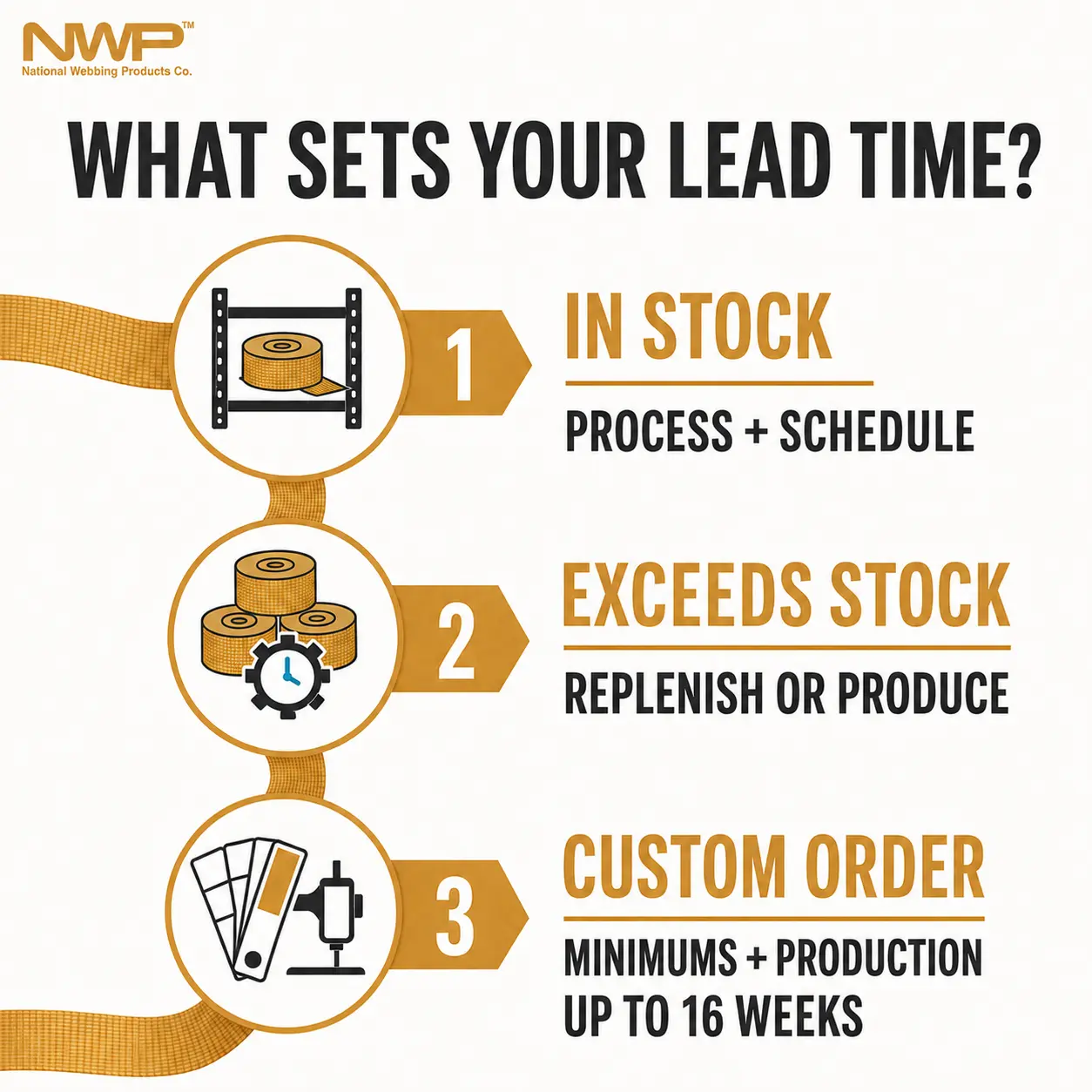
National Webbing Products supplies wholesale webbing to businesses and government agencies. We carry many products in different materials, constructions, widths, colors, and styles. As a result, there is no single lead-time that applies to every nylon webbing order. The first question is whether we have enough of the exact product requested to meet the required quantity.
|
Order situation |
Main timing consideration |
What the buyer should provide |
|
Standard item within available inventory |
Order processing and shipment scheduling |
Correct style number, quantity, price, and requested ship date |
|
Standard item exceeding available inventory |
Additional material or production needed to complete the quantity |
Full requirement, required date, and flexibility regarding delivery |
|
Custom or special-order item |
Minimum quantity, product specifications, production, and delivery |
Complete custom specifications and as much advance notice as possible |
This distinction matters because “standard” and “available” do not mean the same thing. We might carry a particular nylon webbing style without having every width and color in every wholesale quantity ready for immediate shipment. A buyer asking whether we sell a product is therefore asking a different question from whether we have enough inventory for a specific production run.
Our stocking position reflects the quantity currently available for a specific item, style, width, and color. An order might exceed our available quantity even when the requested webbing is part of our standard product range. Large wholesale orders naturally place different demands on inventory than smaller, recurring releases do. We review the complete requirements before providing a ship date because a single general inventory answer would not cover every possible combination.
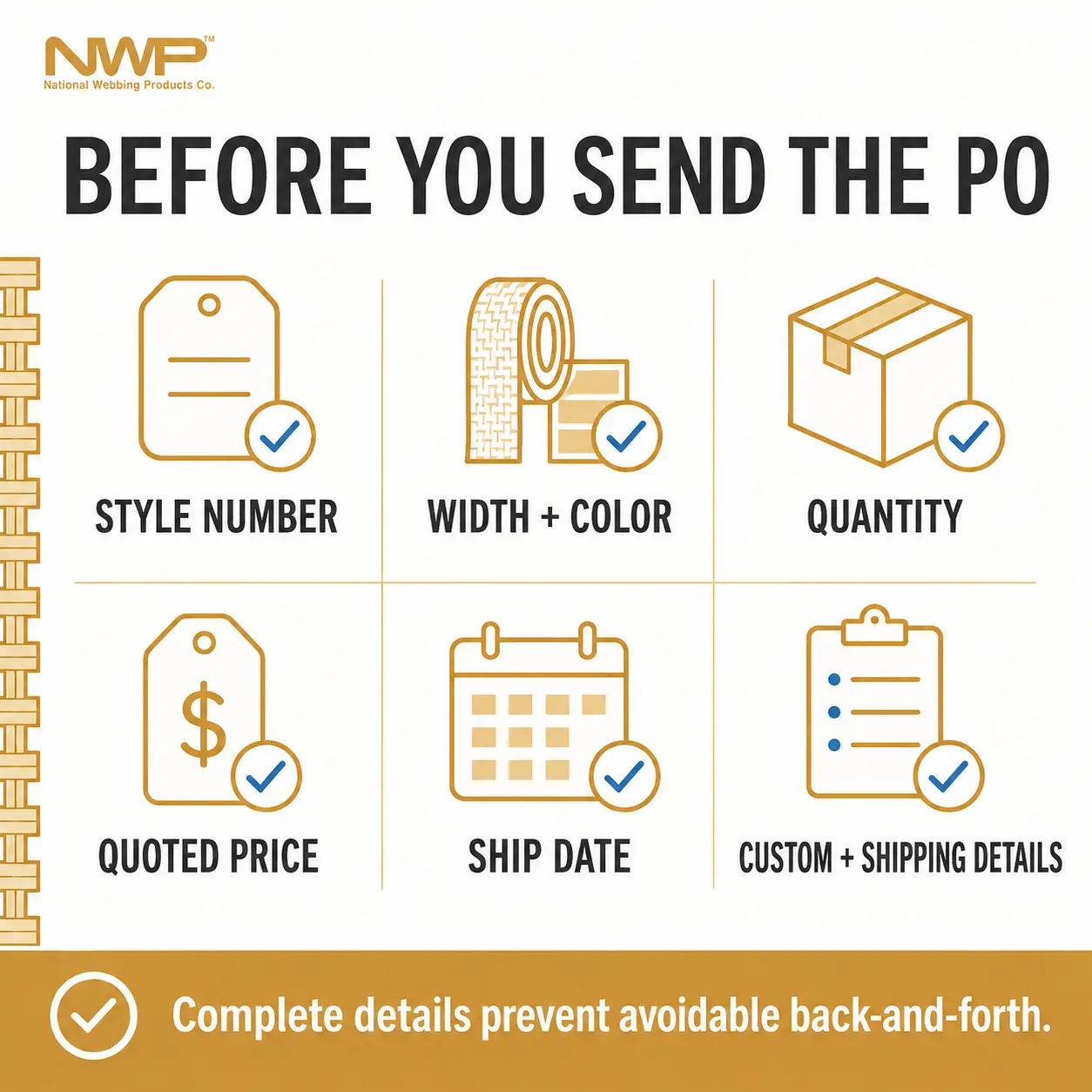
Buyers should identify the exact product rather than relying on a broad description such as “one-inch black nylon webbing.” Relevant details often include:
These details allow us to match the request against the correct product and stocking position. They also reduce the risk of reviewing availability for an item different from the one the buyer needs. For a manufacturer scheduling labor and equipment around incoming material, that precision matters long before the webbing reaches the production floor.
Custom colors, widths, finishes, printing, and other special requirements follow a different path from stocked products. These orders require minimum quantities and longer delivery times. Depending on the item and its requirements, delivery for a special product might take up to 16 weeks. Buyers should account for this longer runway when scheduling a new product launch, seasonal requirement, or custom production run.
Not every special order reaches the full 16-week timeframe. The requested product, quantity, construction, color, finish, and other specifications all influence timing. A custom color might involve different requirements from a standard color in an uncommon width, while printed webbing introduces its own production details. Early specification work gives both parties time to identify those requirements before the material becomes urgent.
A purchase order should answer the basic questions needed to process the order. CIPS defines a purchase order as the buyer’s formal communication confirming the goods, quantity, and specifications required. In our experience, missing style numbers, incorrect prices, and absent ship dates create avoidable back-and-forth. Processing slows while the buyer and our team resolve information that should have accompanied the order.
A complete purchase order does not change the physical availability of a product. It does remove administrative uncertainty from the process. Our team receives a clear request, reviews the correct item, and addresses availability or timing without first rebuilding missing order information.
A purchase order tells us what a customer needs now. A projection gives us visibility into expected requirements over the coming months. The Association for Supply Chain Management identifies future-demand data, inventory information, and technical specifications as important inputs for collaboration between supply-chain partners. ASCM also explains that forecasting and planning help align expected demand with available supply.
A projection is not the same as an immediate order. Its value comes from showing the direction and approximate size of future demand before each purchase order arrives. That visibility helps us prepare for customer needs instead of learning about a major increase only when the material is already required.
A blanket order supports repeated purchases of the same or similar materials over an established period. ASCM recognizes blanket orders as a standard method of procuring materials and services. Instead of treating every recurring requirement as an unrelated purchase, the buyer establishes a broader order and releases quantities according to an agreed schedule. This approach gives both the customer and NWP a clearer view of anticipated demand.
Blanket orders are especially relevant when a manufacturer uses the same nylon webbing year-round but does not need the full quantity delivered at once. The arrangement connects purchasing with the customer’s production schedule. Specific quantities, release dates, terms, and responsibilities still need to be established between both parties. A blanket order provides structure, but accurate forecasts and timely releases remain important.
Contact us before placing an unusually large order, introducing a custom specification, or reaching a critical inventory level. Early contact allows us to review the exact style, width, color, quantity, and required date against current conditions. For recurring requirements, share projections or discuss whether a blanket order fits your purchasing pattern. For special products, allow for minimum quantities and delivery times reaching up to 16 weeks.
Nylon webbing should arrive as one planned part of the production process, not become the material holding everything else in place. A clear specification helps us evaluate the immediate requirement, while complete purchase-order information keeps processing moving. Projections give us visibility into recurring demand, and blanket orders provide structure for planned releases. Custom and unusually large orders require more time because they extend beyond normal stocking conditions. The earlier we understand the complete requirement, the better both teams are positioned to work toward a dependable delivery plan.
