
- Local: (516) 346-4636
- Toll-Free: (800) 886-6060
- Email: kflynn@nationalwebbing.com
A custom strap assembly does not fail on a comparison chart. It fails when webbing bends through hardware, when stitching changes the material's structure, when repeated handling wears down fibers, and when a production run needs to match the last one. That is why the nylon versus polypropylene decision should start with the finished assembly, not the raw material name.
At National Webbing, we look at nylon webbing and polypropylene webbing as material choices inside a larger system. The right question is not whether nylon is always better than polypropylene. The right question is whether the strap assembly needs more durability, better performance around hardware, stronger color and finish control, and repeatable production quality. For many custom strap assemblies, nylon webbing provides manufacturers with a stronger material platform.
When buyers compare nylon webbing and polypropylene webbing, the conversation often starts with cost, weight, or moisture exposure. Those inputs matter, but they do not tell the whole story. A custom strap assembly also includes cut lengths, folded ends, sewn loops, buckles, slides, D-rings, hooks, adjusters, and repeated movement through contact points. The webbing has to work with the entire assembly, not just provide a simple material description.
Recent textile research supports this assembly-first view. A 2024 yarn abrasion study found that repeated stretching and bending create abrasion between contacting yarns, and that abrasion fatigue is one of the main reasons fiber assemblies fail. That matters for webbing buyers because service life is often spent at friction points, not in a clean lab pull. Once the webbing moves through hardware, rubs against itself, or carries repeated tension, the material choice becomes a durability decision.
|
Assembly factor |
Why it matters in nylon vs polypropylene decisions |
|
Hardware path |
Webbing bends, slides, and rubs against buckles, rings, hooks, and adjusters |
|
Stitching |
Needle heat, thread tension, stitch density, and seam geometry change the finished strength |
|
Repeated handling |
Straps get pulled, folded, adjusted, dragged, and gripped over time |
|
Color and finish |
Visible straps affect perceived product quality and repeat-order consistency |
|
Environment |
Moisture, UV, heat, dirt, and chemical exposure change material requirements |
This is where generic “nylon is stronger” content falls short. Strength matters, but custom assemblies need more than starting strength. They need retained performance after sewing, routing, adjustment, friction, and use. That is the practical reason many manufacturers choose nylon webbing over polypropylene for higher-demand strap assemblies.
Polypropylene is not the wrong material. It fits many programs where low weight, lower cost, hydrophobicity, and chemical resistance matter more than abrasion resistance, color flexibility, or high-abuse hardware interaction. A 2024 review of polyolefins describes polypropylene and related materials as low-cost, lightweight, and chemically resistant, which explains why polypropylene remains useful in many textile and industrial applications.
The issue is fit. Polypropylene often makes sense for simpler, lighter, cost-driven programs with fixed colors and lower mechanical severity. Nylon webbing often makes more sense when the strap assembly is part of a higher-value product, a repeat-production program, or a component that has to withstand frequent handling and contact wear.
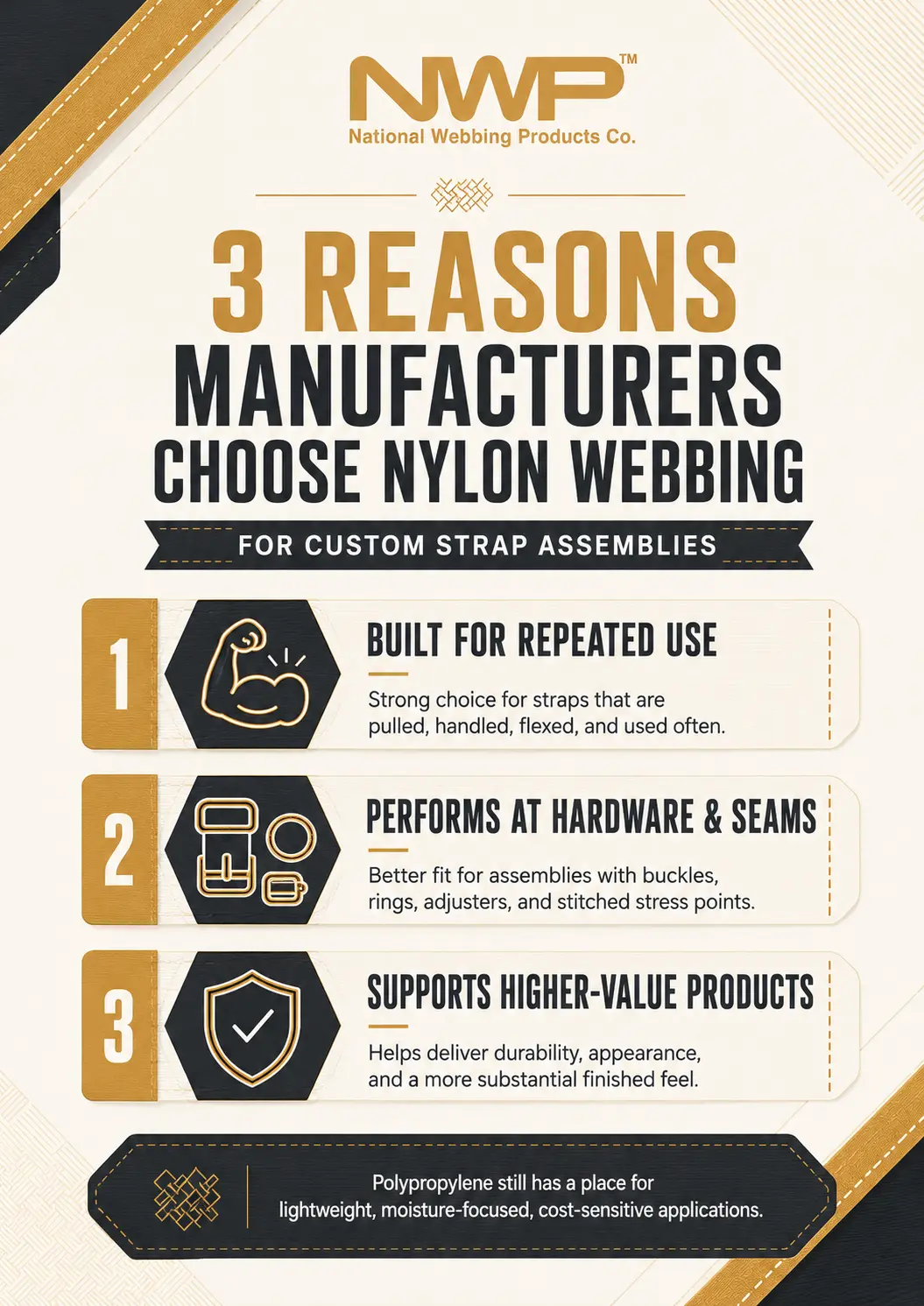
Nylon wins when the finished assembly asks more from the webbing. Polypropylene still has a place when the assembly is lighter, simpler, moisture-focused, or cost-sensitive.
Custom strap assemblies live in motion. They get pulled through adjusters, folded at sewn ends, bent around hardware, dragged across surfaces, and handled over and over. A buyer looking only at starting strength misses the bigger issue. The better question is how much useful performance the webbing keeps after repeated friction, bending, and contact.
The deep research found a strong recent comparison of material levels. A 2025 engineering study comparing PA6G, PA6, polypropylene, PTFE, and MDPE under loaded wear conditions found that PA6 and PA6G showed the highest wear resistance, while polypropylene showed some of the highest wear rates at all tested loads. The same study concluded that PA6G and PA6 performed better in resistance, hardness, and impact strength, while polypropylene was better suited for lower-load-bearing applications.
That study was not a narrow, woven-webbing study, so the claim should remain disciplined. It does not prove every nylon webbing construction beats every polypropylene webbing construction in every assembly. It does support a material-level direction that matters in real products: nylon starts from a stronger wear and toughness profile when repeated contact is part of the job.
|
What the strap assembly experiences |
Why nylon often fits better |
|
Repeated pulling |
Nylon gives the assembly more toughness reserve under frequent use |
|
Surface abrasion |
Nylon’s wear profile supports higher-contact applications |
|
Bending and folding |
Nylon fits assemblies that flex and move through service |
|
Daily handling |
Nylon often gives a more substantial product feel |
|
Higher-value use |
Nylon supports products where the strap is part of quality perception |
A 2025 study on high-tensile nylon 6,6 webbings used in military applications also reinforces the role of nylon in demanding webbing systems. The study tied nylon 6,6 webbing selection to tensile strength, abrasion resistance, elongation behavior, and a higher melting point. That source focused on UV degradation rather than a direct nylon-versus-polypropylene webbing comparison. The useful point is narrower and more relevant: high-consequence webbing applications continue to use nylon when load-bearing performance and operational reliability matter.
The strongest reason to choose nylon webbing over polypropylene for custom strap assemblies is not the webbing by itself. It is the way the webbing works around the parts of the assembly where problems usually start. Buckles, slides, D-rings, hooks, adjusters, sewn loops, folded ends, and stitch rows create local stress. Those areas turn a material choice into an assembly decision.
Recent sewing research provides strong support for this point. A 2025 technical textile study found that heating the sewing needle causes burnt spots, thread breakage, and reduced seam strength. It also reported a general trend of 25% to 30% lower seam strength at higher sewing speeds, driven by friction and heat damage during sewing. That matters because a custom strap assembly is not a strip of webbing after sewing. The seam line changes the structure, strength, and service behavior of the component.
A 2022 woven-fabric study adds another layer. It found that sewing either displaces yarns or damages them, and that denser constructions with higher friction showed greater damage at the needle-piercing point. The study was not specifically about nylon and polypropylene webbing, but the assembly lesson is direct. Stitching, needle choice, stitch density, fabric structure, and friction all affect finished performance.
Thermal margin also matters around sewing and friction. The 2025 nylon webbing study placed nylon 6,6 near a 265 °C melting point, while a 2024 polypropylene study reported a melting peak around 160 °C to 170 °C for polypropylene. That does not prove every sewn nylon assembly outperforms every sewn polypropylene assembly. It supports a careful manufacturing inference: nylon provides greater thermal headroom in friction and sewing zones, where heat, contact, and yarn damage affect finished performance.
Some strap assemblies hide inside a product. Others are visible, handled, adjusted, pulled, and judged by the end user. In those cases, the webbing affects more than mechanical function. It affects how the product feels, how it wears, how it looks after use, and whether the next production run matches the last one.
Nylon often gives manufacturers more room when color and finish matter. A 2024 study on nylon fibers dyed with low-water-soluble reactive dyes reported fixation above 91% and washing and rubbing fastness above grade 4. Another 2024 industrial-scale polyamide dyeing study found good color strength and satisfactory fastness against repeated washing, rubbing, water, and perspiration on nylon. Those findings support a practical point about custom webbing: nylon offers manufacturers a more flexible path for custom color and finish programs.
Polypropylene has a different color story. A 2024 Scientific Reports study found that regular polypropylene fabric had low color strength due to limited dye sites, low water sorption, and its highly hydrophobic nature. Better dye uptake required polypropylene nanocomposites and supercritical CO2 processing. A 2025 Scientific Reports paper also stated that spin dyeing is the standard coloring method for polypropylene fibers.
|
Production need |
Nylon advantage |
|
Custom colors |
Nylon supports broader post-weave coloration routes |
|
Visible straps |
Nylon helps support a stronger finished-product impression |
|
Repeat production |
Nylon gives more process flexibility for matching product requirements |
|
Higher-value assemblies |
Nylon supports quality where the strap is handled and seen |
|
Buyer confidence |
Nylon fits programs where durability, appearance, and sourcing consistency all matter |
The right claim is not that polypropylene is inconsistent. The right claim is that nylon gives a custom-program manufacturer more process room. When a buyer needs repeatable shade, clean hand feel, a durable finish, and a strap that aligns with the product’s value, nylon webbing often offers the better option.
For custom strap assemblies, nylon webbing is often the better choice when the material has to do more than fill a low-cost slot on a bill of materials. It is the better fit when the strap sees repeated use, when hardware and stitch points matter, when the webbing is visible or handled, and when the manufacturer needs repeatable quality across production. Polypropylene still belongs in the conversation, especially for lighter, simpler, cost-sensitive, and moisture-focused programs.
The better question is not, “Which material is better?” The better question is, “What does the finished strap assembly have to do?” If the answer includes abrasion, tension, sewn construction, hardware movement, custom color, product feel, and repeat production, nylon webbing gives manufacturers a stronger starting point.
