
- Local: (516) 346-4636
- Toll-Free: (800) 886-6060
- Email: kflynn@nationalwebbing.com
A wholesale nylon webbing quote should start with the finished product, not the roll. Width, color, and quantity matter, but those details do not explain how the webbing functions in production, what it passes through, how it will be sewn, or whether the same material needs to repeat across future orders.
At National Webbing Products Co., we sell wholesale to businesses and government agencies. Before requesting a wholesale nylon webbing quote from us, ensure you've prepared the webbing's job, physical requirements, hardware or sewing interface, supply format, quantity, and repeat-order needs.
Before we recommend a wholesale nylon webbing option, we need to understand what the webbing does in the finished product. A strap used for adjustment creates a different quote conversation than binding tape, a sewn-in loop, a reinforcement piece, or a visible component on a finished product.
This is not only our preference as a supplier; it is also our commitment. The Federal Acquisition Regulation says acquisition requirements should describe the function to be performed, the performance required, or the essential physical characteristics. For a manufacturer ordering wholesale nylon webbing, the same logic applies: the request becomes more useful when it explains what the webbing needs to do, rather than just the material name.
Start with the part. Tell us whether the webbing carries, adjusts, binds, reinforces, connects, finishes an edge, or passes through hardware. Also, tell us whether it is fixed or adjustable, visible or hidden, sewn into another part, folded around hardware, or cut to a repeated length.
| Webbing Detail | Why It Matters |
|
Function |
Defines the job |
|
Width |
Affects fit |
|
Hardware |
Affects assembly |
|
Supply format |
Affects production |
|
Reorder need |
Affects consistency |
These details help us understand the production requirements before we discuss the material path. They also help separate a basic material request from a quote-ready production request.
Once we understand the webbing’s job, the next step is narrowing the physical requirements. Width and color are useful starting points, but they are not the full specification. We also need to know whether the request involves lightweight nylon, heavyweight nylon, nylon tape, commercial construction, military specification construction, or a prior part we should match.
Our product structure reflects this. NWP’s product navigation separates nylon webbing into lightweight, heavyweight, and tape categories, meaning “nylon webbing” is not a single quote path. The category matters because it affects how the material fits the finished product and how the order should be discussed.
This does not mean you need every technical answer before contacting us. If you do not know the construction family, tell us what the webbing does. Send a photo, drawing, sample, or prior part if you have one.
That is more useful than guessing.
NIST research gives a useful parallel. Its capital facilities study found that inadequate interoperability resulted in $15.8 billion in quantified annual costs in 2002. The study is not about webbing quotes, so we should not stretch it beyond its use. However, it does highlight how unclear technical information creates measurable inefficiency in complex production environments.
For wholesale webbing, the practical lesson is narrower. A clearer request reduces unnecessary back-and-forth before we understand the part, the assembly, and the order format.
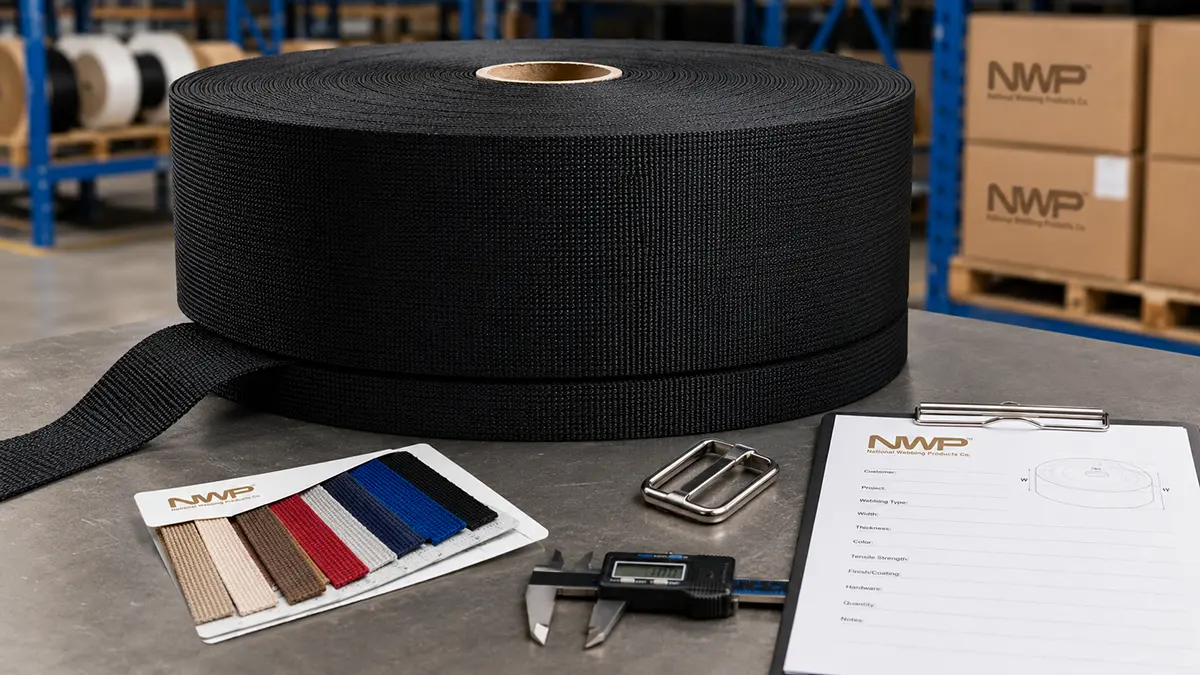
Webbing rarely works alone in a manufactured product. It often passes through a buckle, slide, ring, hook, adjuster, sewn loop, folded end, or stitched assembly. If our nylon webbing needs to work with hardware or sewing, we want to know that early.
This matters because width should match the assembly, not only the buyer’s first preference. A buckle opening, slide size, ring diameter, folded end, or stitch path changes how the webbing needs to behave. If the hardware is already selected, include the part number or slot size with the quote request.
If the sewing operation is already planned, include that too. Tell us whether the webbing will be stitched flat, folded over, looped, stacked, bound, or cut into repeated pieces. Our manufacturing capabilities include raw materials, plastic hardware, metal hardware, tape, webbing, pre-cutting, and sewing services, so the interface details help us understand the full production need.
That small difference changes the conversation about the quote.
A wholesale quote should define how the material needs to arrive. Some customers need roll goods because they cut and assemble materials in their own facilities. Others need cut pieces because they use the same part length repeatedly.
This is not a consumer convenience issue. It is a production format issue.
If you need rolls, tell us the expected yardage and how your production team will use the material. If you need cut pieces, tell us the length, quantity, and whether the same part will repeat across future production runs. If you are replacing an existing component, a sample or drawing helps us understand the finished part.
At NWP, we provide cut pieces for special requirements, as well as pre-cutting and sewing services. Those capabilities are most useful when the buyer explains the supply format early, rather than treating it as a detail after price.
Color is not only a visual choice when you buy wholesale nylon webbing. For a manufacturer, color might need to match a product family, a private-label program, a previous order, or a planned reorder. Tell us whether the color is fixed, flexible, stock-based, or part of a longer-term production program.
This is where buyers should think past the first order. If the first run is black, but the next three product lines need matching colors, that changes the planning conversation. If the color is flexible, say that. If it needs to match an existing product, send a sample or reference. Color should not drift into branding theory here. The question is production consistency.
| Color Question | Reason |
|
Fixed or flexible? |
Narrows options |
|
Stock or custom? |
Guides path |
|
Match required? |
Supports consistency |
|
Reorder expected? |
Helps planning |
A wholesale customer often needs the same material again. That makes repeatability part of the specification, not a detail to solve later.
A wholesale nylon webbing quote is easier to guide when we understand the part before we discuss the roll. Width, color, and quantity are useful starting points, but they do not tell us how the webbing works inside your product, what hardware it needs to fit, how it will be sewn, or whether the same material needs to repeat across future production runs.
The best first request gives us a clear view of the production need. Tell us what the webbing does, what physical requirements matter, whether it needs to work with buckles, slides, rings, hooks, or sewing, and whether you need roll goods, cut pieces, or repeatable parts. If you have a drawing, sample, photo, or prior part, send that too.
Those details help us have a better wholesale conversation from the start. They give our team the information needed to understand the application, narrow the right nylon webbing path, and discuss the next step with less guesswork.
