
- Local: (516) 346-4636
- Toll-Free: (800) 886-6060
- Email: kflynn@nationalwebbing.com
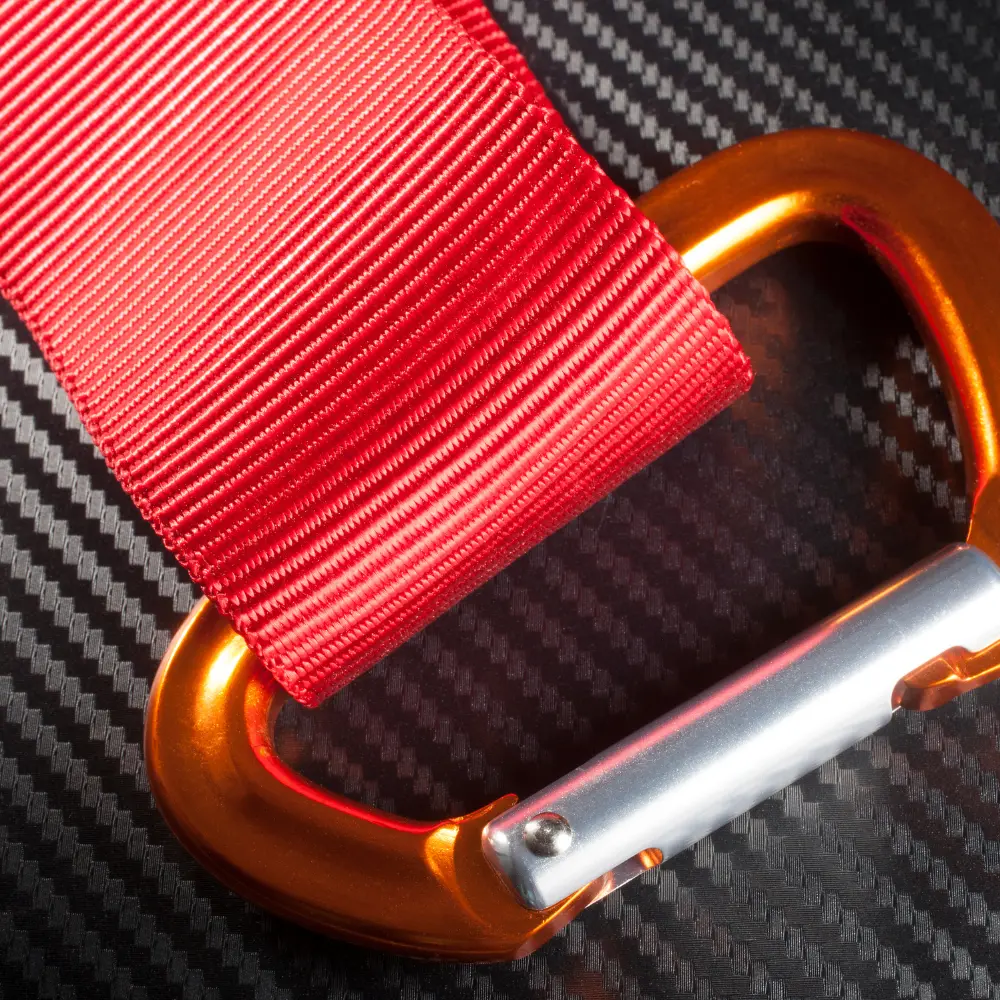
Search terms like "types of plastic clips," "types of plastic fasteners," and "strap hardware" often surface when something in a strap assembly isn't behaving as it should. A buckle keeps creeping out of adjustment, a slide binds during threading, a ring cracks after exposure, or a cord lock stops holding tension after repeated use. These are rarely dramatic failures, but they are expensive ones because they show up after products are already in use.
Those problems rarely come from choosing the "wrong category" of hardware. They come from choosing hardware based on assumptions that seem reasonable on paper but fall apart in practice. Nylon webbing is not a perfectly uniform input, and strap assemblies do not operate in controlled environments. They live in heat, cold, UV exposure, moisture, vibration, and constant handling. At scale, those variables stop being edge cases and start becoming rework, returns, and inconsistent builds.
Plastic fasteners for nylon webbing are not interchangeable. The correct choice depends on how the polymer behaves under real conditions, how the hardware interfaces with the webbing, and how the assembly will actually be loaded and used over time.
Most commodity content treats plastic hardware like a dictionary. It lists categories, gives surface-level descriptions, and assumes the reader will sort out what applies. That approach works for browsing, but it fails for specification. Real problems arise when hardware is selected by name rather than by behavior.
Each of those assumptions produces predictable failures.
Plastic fasteners do not fail in isolation. They fail in environments, and the behavior of the polymer in those environments determines whether a fastener maintains its geometry and function over time. Many strap systems never experience a clean break. They fail through slow deformation, loss of holding power, brittle cracking after exposure, or subtle changes in fit that only appear after weeks or months.
Material choice matters because different plastics respond very differently to heat, cold, UV, moisture, and sustained tension. Some materials maintain dimensional stability under load, while others slowly creep and change the friction path that keeps a strap adjusted. Some become brittle in cold conditions, while others soften enough in heat to allow slip where none existed before.
This is why strap hardware is not specified solely by strength. Buckles, slides, rings, and cord locks are often made from materials explicitly chosen for creep resistance and long-term stability, not just impact strength. Shoulder pads are a useful contrast here because their job is not structural at all. They exist to provide surface feel, flexibility, and comfort, which is why softer plastics are appropriate there even when they would be a poor choice for load-bearing geometry.
Material behavior answers the first question: will this fastener keep doing its job after exposure, cycling, and time under load, or will it slowly change over time until the assembly no longer works as designed?
Once the polymer is right, performance still collapses if the interface between the fastener and the webbing is wrong. Most functional failures in strap assemblies are interface failures, not material failures. They show up as slip, creep-back, poor feeding, and inconsistent adjustment.
Webbing width alone is not enough to select hardware. Thickness, stiffness, weave, coatings, and surface friction all change how webbing behaves inside a buckle or slide. Two fasteners that both claim to fit "1-inch webbing" can perform very differently once those variables are introduced.
Slides make this especially clear because their entire purpose is controlled adjustment. A standard slide may work perfectly with one webbing construction and bind or creep with another. This is where geometry matters as much as material.
Strap locks and slides with keepers exist for the same reason. They solve migration and back-out that happens when movement and vibration gradually defeat friction-based adjustment. If hardware selection ignores the interface, problems get blamed on "weak plastic" when the real issue is geometry and friction mismatch.
Even when the material choice and webbing interface are correct, load behavior can still cause a system to fail. Strap assemblies are exposed to static tension, dynamic shock, vibration, repeated cycling, and off-axis pull. Each of these conditions stresses hardware differently, and many real-world failure modes never appear in simple pull tests.
Static tensile strength is useful, but it does not predict what happens once a strap assembly starts moving, flexing, and being adjusted in real use.
A buckle that performs perfectly under a straight pull can behave very differently when:
In those cases, slip, deformation, fatigue, or accidental release can occur long before anything actually breaks.
This load reality is the reason different buckle designs exist, not aesthetics or marketing segmentation.
Each design is a response to a different load behavior problem.
Rings, loops, and triangles sit at the center of load reality because they are attachment points and routing components. They routinely experience:
These stresses concentrate force in ways that straight-pull ratings do not capture. Selecting attachment hardware without considering load direction often leads to cracking and fatigue that looks mysterious until the load path is examined.
Plastic fasteners fail when they are selected by name rather than by behavior. The most reliable strap assemblies come from recognizing three realities: plastics behave differently under real conditions, webbing interfaces are friction systems with inherent variability, and load conditions rarely match a simple static test. Once fasteners are treated as solutions to failure modes instead of catalog items, "types of plastic fasteners" becomes an easy conversation rather than a risky one.
