
- Local: (516) 346-4636
- Toll-Free: (800) 886-6060
- Email: kflynn@nationalwebbing.com
A nylon webbing choice can look correct on a spec sheet and still fail in the product. A 1-inch black strap may be too stretchy for load control, too thick for an adjuster, too stiff for skin contact, or too moisture-sensitive for the use environment.
The safer sourcing path is to define load, exposure, stretch, hand feel, width, thickness, weave, finish, sewing method, and hardware fit before requesting a quote or sample.
Nylon webbing is a woven strip made from nylon fibers, commonly used when strength, abrasion resistance, flexibility, and a softer hand matter. Britannica describes nylon as a synthetic plastic material made from high-molecular-weight polyamides. In webbing form, nylon is used in bags, straps, pet products, outdoor gear, handles, and load-related assemblies.
Material name is not enough. Two 1-inch nylon webbings can behave very differently. One may be soft and easy to fold. Another may be dense, firm, and better at resisting edge abrasion. Width alone does not prove fit.
|
Specification Variable |
What It Changes |
Risk When Ignored |
|
Width |
Contact area, comfort, buckle fit, visual scale |
Poor fit with hardware or product proportions |
|
Thickness |
Bulk, stiffness, sewability, feed-through behavior |
Jamming, bulky folds, difficult sewing |
|
Yarn size or denier |
Strength, texture, weight, hand feel |
Wrong strength or product feel |
|
Weave |
Flexibility, texture, edge stability, abrasion response |
Early wear or poor handling |
|
Finish |
Surface feel, color, water behavior, processability |
Wrong comfort, appearance, or handling |
|
Attachment method |
Final strength, fold bulk, stress points |
Weak seams, excess bulk, failure at bends |
Nylon webbing is often a strong fit when the product needs strength, abrasion resistance, flexibility, and a smoother or more premium hand. It can work well for shoulder straps, handles, collars, leashes, and consumer products where comfort and repeated bending matter.
It becomes riskier when sustained water exposure, high UV exposure, very low stretch, or lowest cost matters more. Curbell Plastics notes that nylon absorbs moisture from the environment. Nylon can also stretch more than some alternatives, which may be unacceptable in load-control or tight-adjustment systems.
Ask first: will the webbing face sunlight, water, chemicals, repeated abrasion, heavy loads, skin contact, or tight hardware bends? A yes does not rule out nylon, but it means the specification needs closer review.
|
Application Priority |
Nylon Webbing Fit |
Selection Risk |
|
Soft hand and comfort |
Often strong |
Confirm thickness and edge feel |
|
Abrasion resistance |
Often strong |
Confirm weave and contact points |
|
Low stretch |
Compare alternatives |
Polyester may be safer |
|
Water exposure |
Compare alternatives |
Polyester or polypropylene may reduce moisture risk |
|
Long UV exposure |
Compare alternatives |
Polyester may be safer |
|
Lowest cost |
May not fit |
Polypropylene may be better |
A shoulder strap may value softness, abrasion resistance, color, and comfort. A tie-down must prioritize tensile strength, elongation, hardware fit, and safety margin. Same material family, different requirements.
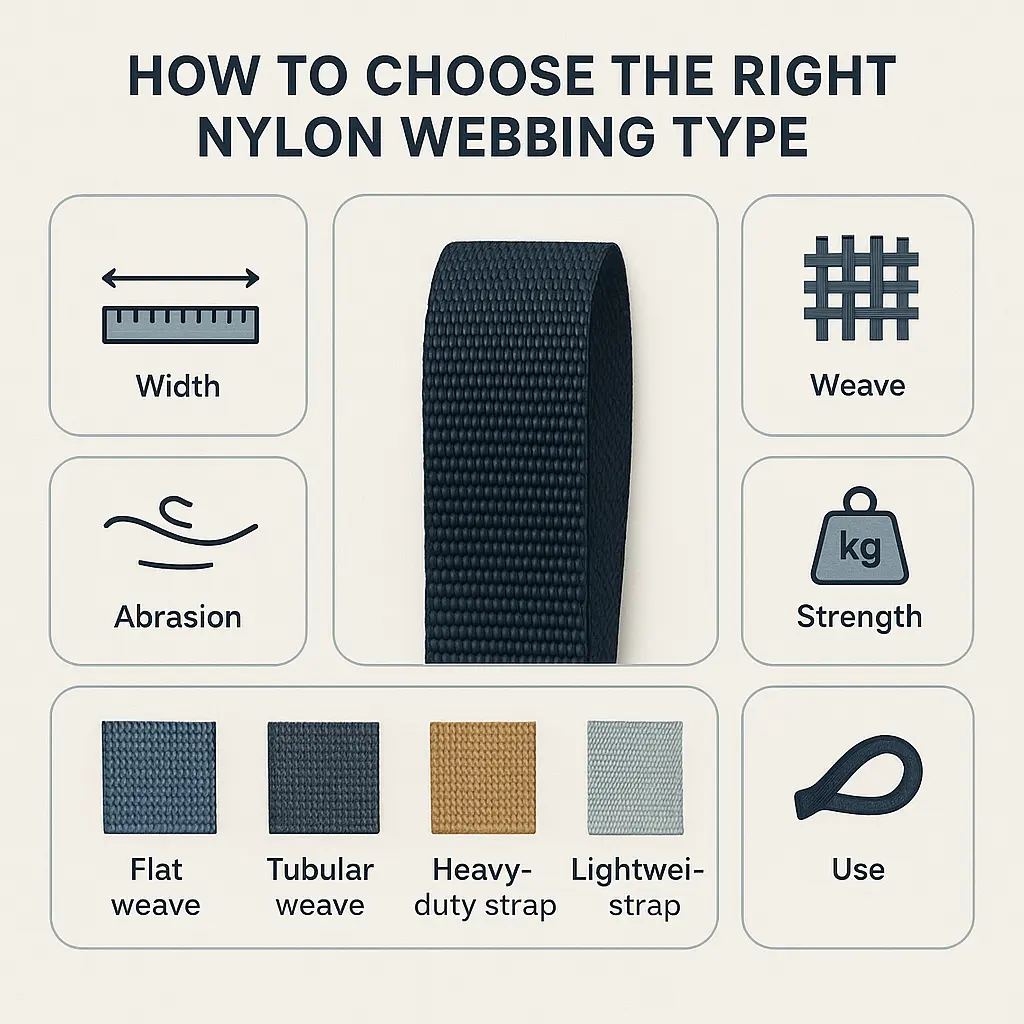
Specify nylon webbing by translating the end use into measurable requirements. The goal is to define how the webbing must behave in the finished product, not how it looks in isolation.
|
Question |
Define Before Sampling |
Common Failure Mode |
|
What load will it carry? |
Expected load, static or dynamic load, safety margin |
Under-specifying strength |
|
Where will it rub? |
Contact points, edge wear, hardware movement |
Fraying or early abrasion |
|
What environment will it face? |
Moisture, sunlight, heat, dirt, chemicals |
Moisture, UV, or surface failure |
|
How much stretch is acceptable? |
Low stretch, moderate give, comfort-focused flexibility |
Poor control or poor comfort |
|
How should it feel? |
Softness, stiffness, foldability, skin contact |
Bad comfort or weak product feel |
|
What size is needed? |
Width and thickness together |
Bulk, jamming, poor sewing |
|
What hardware is used? |
Buckles, adjusters, hooks, loops, triglides, sewn folds |
Slipping, binding, twisting, bulky folds |
|
What construction is needed? |
Weave, edge behavior, finish, colorfastness |
Wrong texture, wear, or appearance |
Width and thickness must be chosen together. Wider is not automatically better because it can add bulk, weight, cost, and sewing difficulty. Thicker may feel stronger, but it can prevent smooth movement through buckles or adjusters.
Weave and finish complete the practical specification. Weave affects texture, flexibility, edge behavior, and abrasion resistance. Finish affects feel, color appearance, water behavior, and processing. Color is not purely visual when exposure, colorfastness, or brand matching matters.
Most nylon webbing failures occur when buyers treat webbing as a simple strap rather than a performance part. These mistakes often appear during sampling, assembly, or field use, when a buyer learns the material matched the visual request but not the application.
Over-specification is common. A heavier construction can make the product stiffer, bulkier, more costly, or harder to sew without improving performance. Match the construction to actual use, not to the heaviest available option.
Before requesting pricing or samples, create a brief nylon webbing requirements sheet. This gives the supplier enough context to recommend a webbing that fits the product, hardware, sewing method, and use environment.
|
Field |
Provide |
|
Application |
Bag strap, pet product, handle, tie-down, outdoor gear, or other use |
|
Expected load |
Static load, dynamic load, required safety margin |
|
Environment |
Indoor, outdoor, wet, high-UV, dirty, hot, chemical exposure |
|
Abrasion exposure |
Rubbing surfaces, edge contact, hardware movement |
|
Stretch tolerance |
Low stretch, moderate give, comfort-focused flexibility |
|
Desired feel |
Soft, firm, flexible, structured, smooth, textured |
|
Size |
Target width and thickness |
|
Construction |
Weave, edge preference, finish preference |
|
Color and length |
Color, exposure needs, cut length, roll length, piece length |
|
Quantity and attachment |
Order volume, sewing method, buckles, adjusters, loops, hooks, triglides |
Ask for technical input when nylon webbing supports weight, faces harsh outdoor conditions, runs through hardware, contacts skin, requires a specific feel, or carries safety-related risk. The right question is not only whether the material is nylon. The right question is whether the finished strap or assembly will handle the actual use case.
Choose nylon webbing when strength, abrasion resistance, flexibility, and hand feel matter most. Compare polyester, polypropylene, or another webbing when lower water absorption, higher UV resistance, very low stretch, or lower cost matters more.
